01 · CARE WELLNESS SUITE · SEP 2022 – NOV 2024 · B2B2C HEALTH · COMMERCE · ENTERPRISE DATA
Helping employees understand and complete one useful wellness action inside a programme HR could run
Role
Lead Product Designer & Researcher
Client
Care × Raffles Medical Group
Timeline
Sep 2022 – Nov 2024
I led the employee Wellness Zone and its shipped Form/check-in journey, then designed the HR Form Builder with my PM and engineering squad. The POC tested product, HR activation, communications, rewards, and account support together. We could not attribute adoption to one feature.
Shipped employee interaction · Apr–Nov 2024 POC
Employee Pulse turned a broad invitation into one clear task
I owned the employee interaction from the introduction through required-answer feedback and the completion state. Content, engineering, product rules, and programme delivery were collaborative.
Shipped Employee Pulse journey, shown through a redacted prototype recording. The IPSS demo used in the interview deck is a separate Forms journey I owned.
ProductionOwned
70%
reported programme adoption within an eligible population of about 4,700
~20%
programme users relative to roughly 20,000 Raffles Connect MAU
≈3
monthly sessions among engaged Wellness users; retention was not measured
Q1 2024
POC SOW signed after prototype-led prospecting
How the pieces connect
Wellness participation
EVENTS · FORMS · CHALLENGES
→
Points earned
THE EARN MECHANIC
→
Marketplace discovery
USE MY POINTS
→
Redemption
POINTS BECOME THINGS
→
HR / sales insight
THE DASHBOARD
↺ insight funds the next programme → more participation → the loop turns again
WHAT I DID
01
Led the employee Wellness Zone and the end-to-end Form/check-in journey from research through the April 2024 POC and November 2024 handover.
02
Led collaborative research with 6 employees and 2 HR administrators; the sample supported hypotheses but could not support representative or causal claims.
03
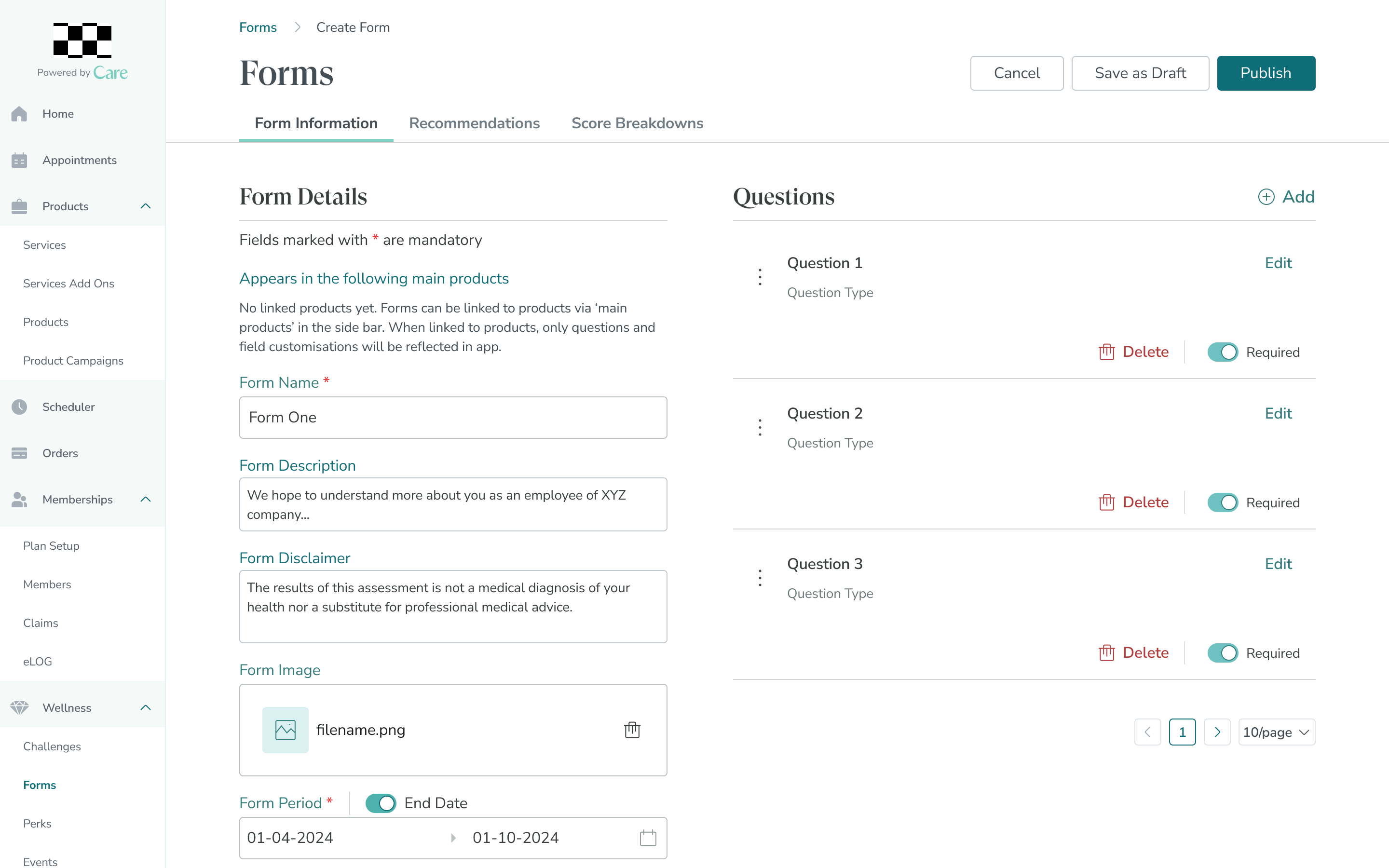
Designed the HR Form Builder with my PM and engineering squad. Product rules, content, implementation, and programme delivery were shared.
04
Co-designed the points and rewards model with the squad; ownership of later marketplace and checkout work stayed shared.
05
Built redacted prospecting prototypes that made the two-sided B2B2C service concrete before production code existed.
06
Designed the HR analytics experience used in prospecting. It demonstrated reporting capability and an identified opportunity. Revenue and ROI remained unverified.
Act 1
The participation problem: one clear action inside a two-sided system
User problem
Employer-funded benefits still felt like work
Employees struggled to understand and track employer-funded benefits, claims were slow, and wellness programmes did not motivate everyone in the same way. The employee task was to discover, understand, and complete a relevant wellness action. The operating task was to give HR a configurable programme without implying that tooling alone would create participation.
01
Choosing an employer-led model
We needed to choose between a consumer app and an employer-led model. Interviews with existing partners pointed to employers as the main activation channel.
02
Making the product credible before launch
We needed a prospective corporate partner to understand a future service without a user base or a live product. The prototype had to make the system concrete enough for commercial evaluation.
03
Fitting Wellness Zone into Care
Wellness Zone had to sit beside medical records and the marketplace without confusing people who already used Care.
Before Wellness Zone · September 2022
Care already taught employees two distinct jobs
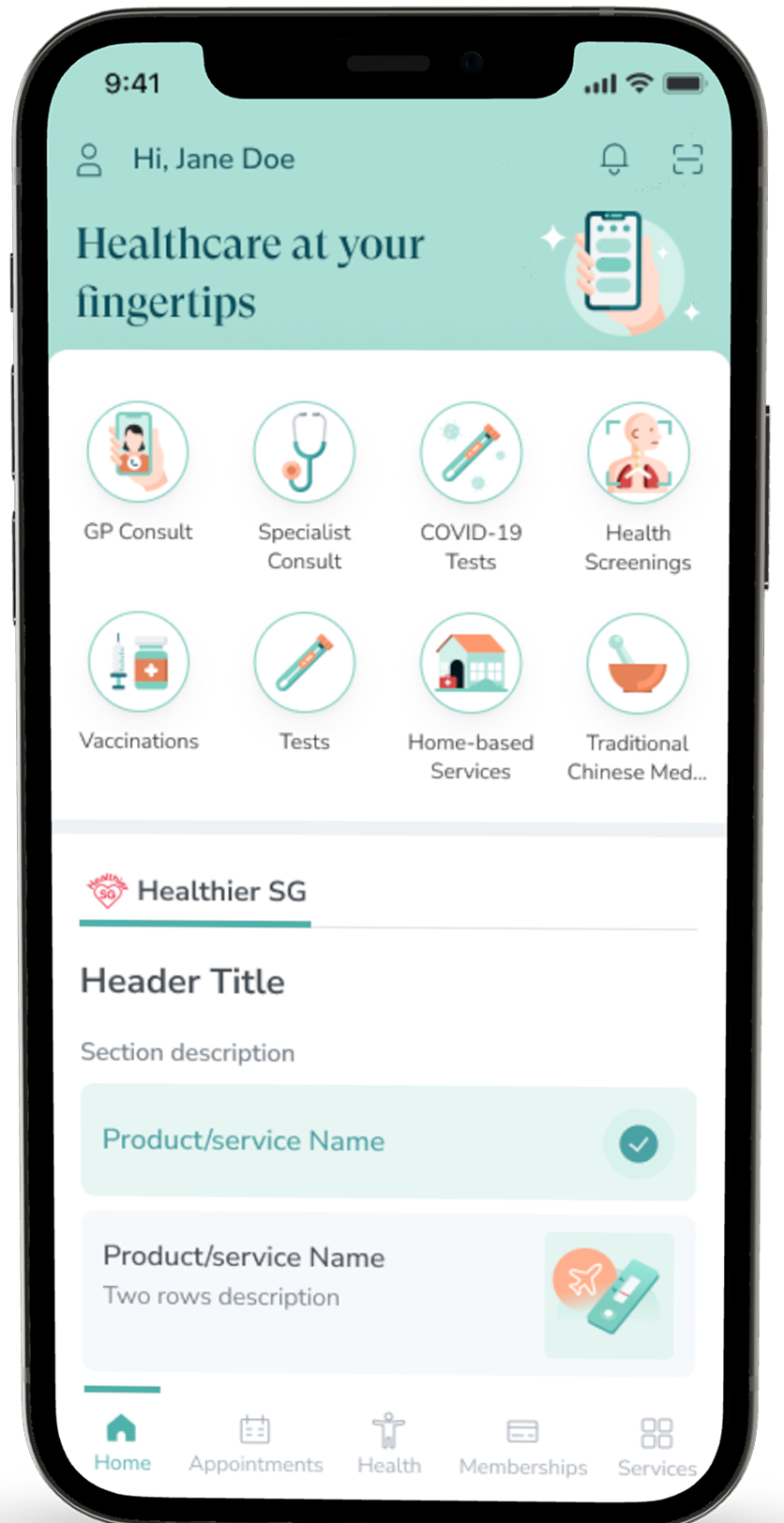
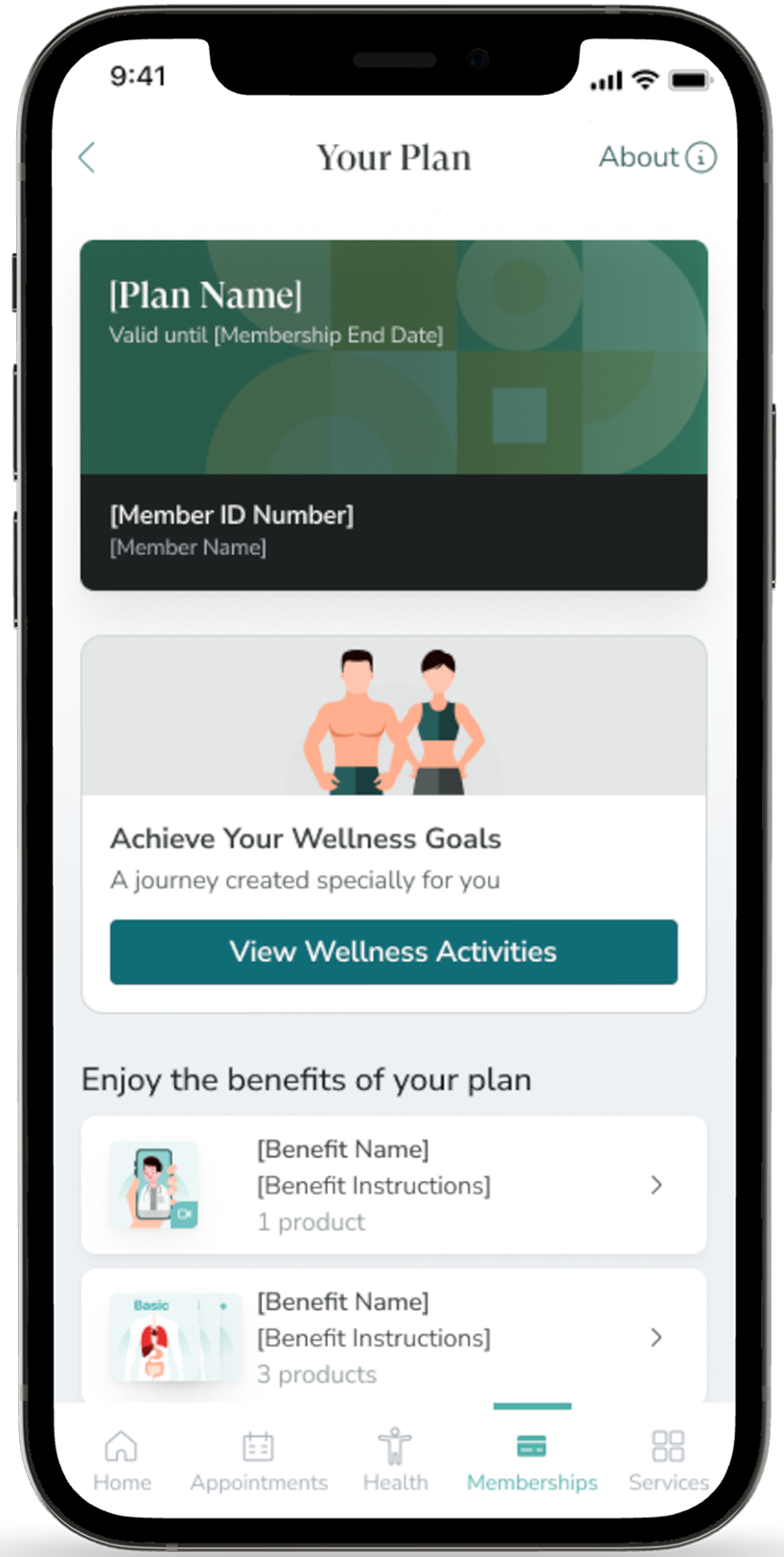
Home was the route into healthcare services; Membership was where an employee found their corporate plan and benefits. Wellness had to extend that corporate-benefits mental model without creating a third, disconnected destination.
Home · healthcare services
Membership · corporate benefits
Research · Jan 2023
We studied why funded benefits still felt hard to use
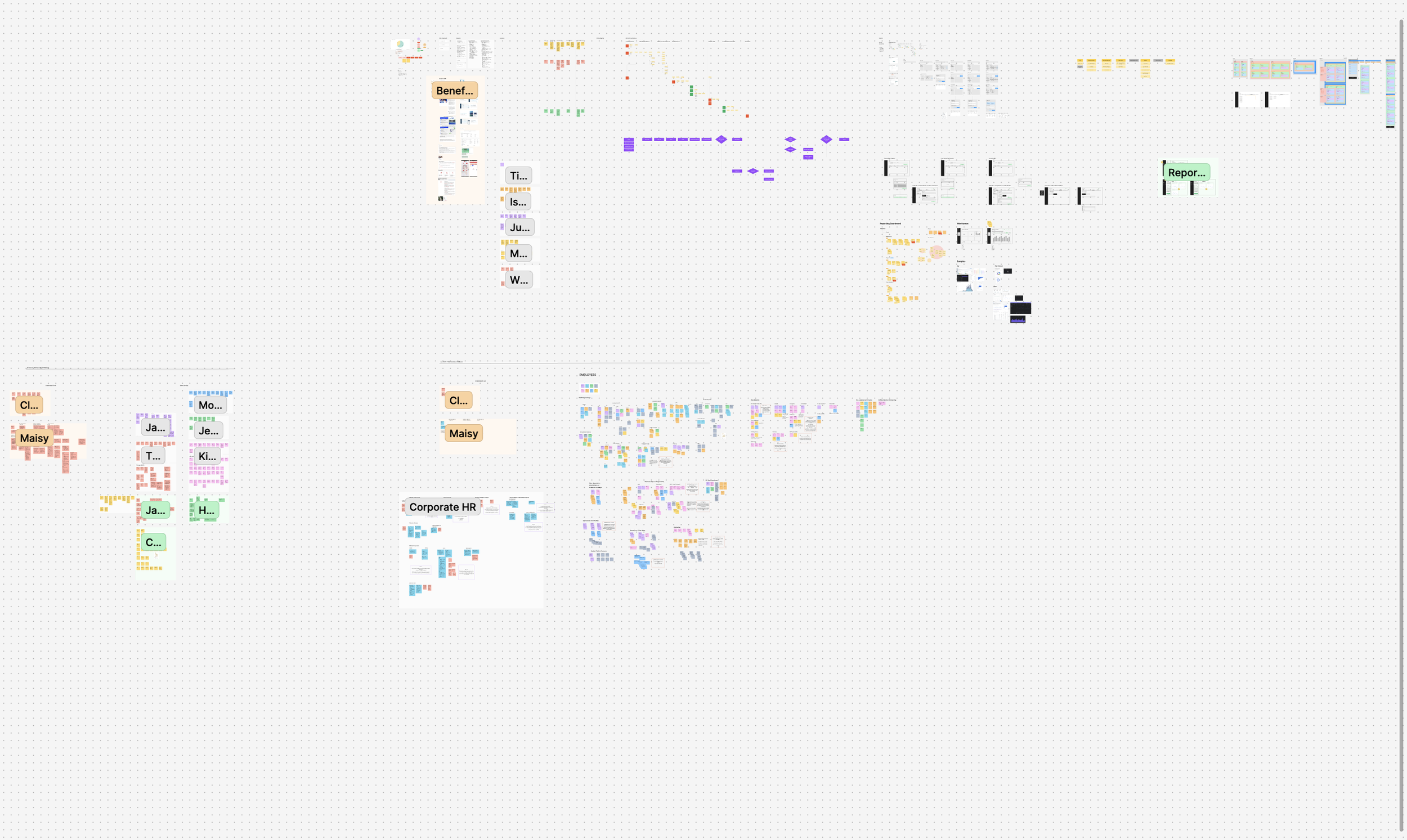
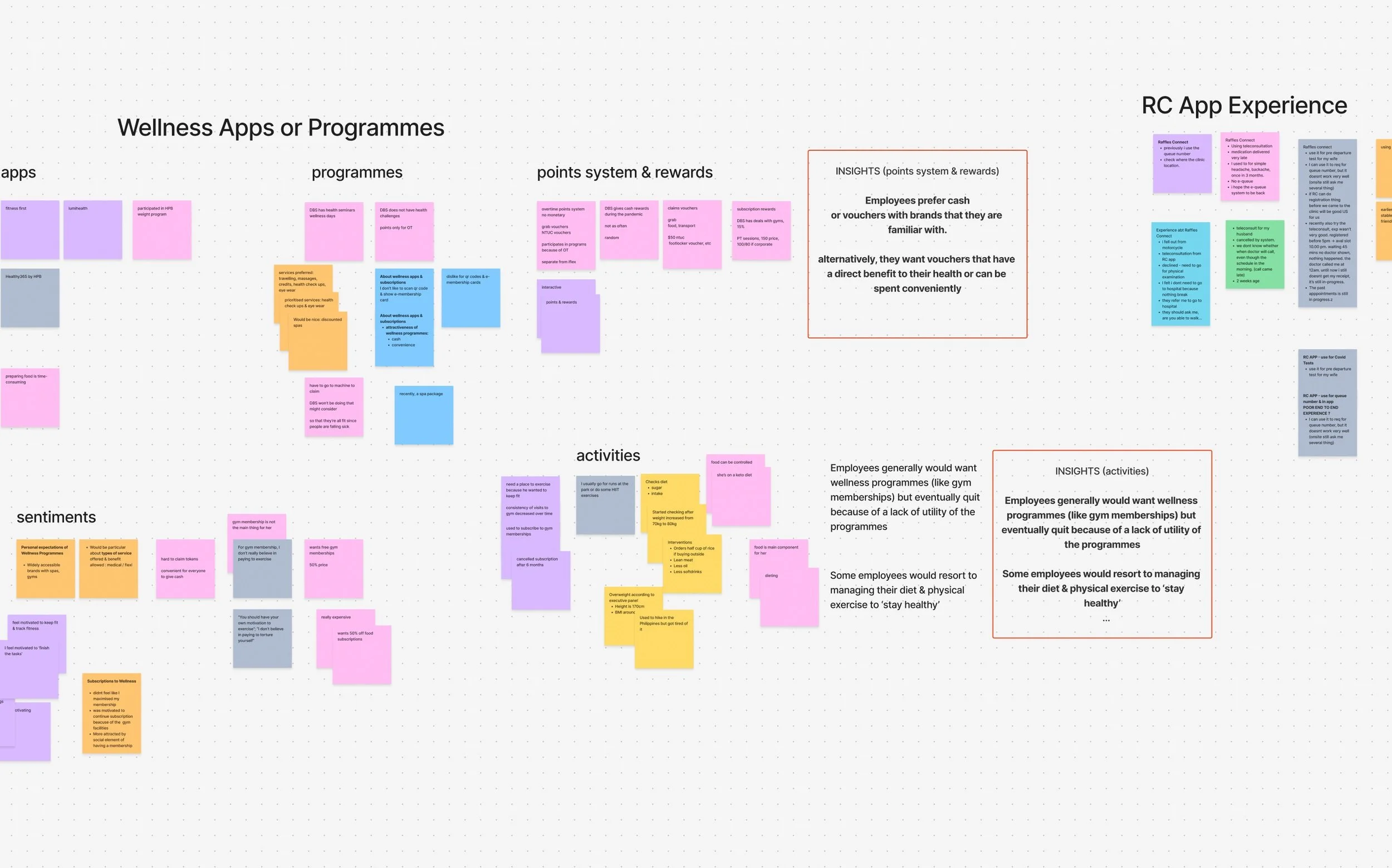
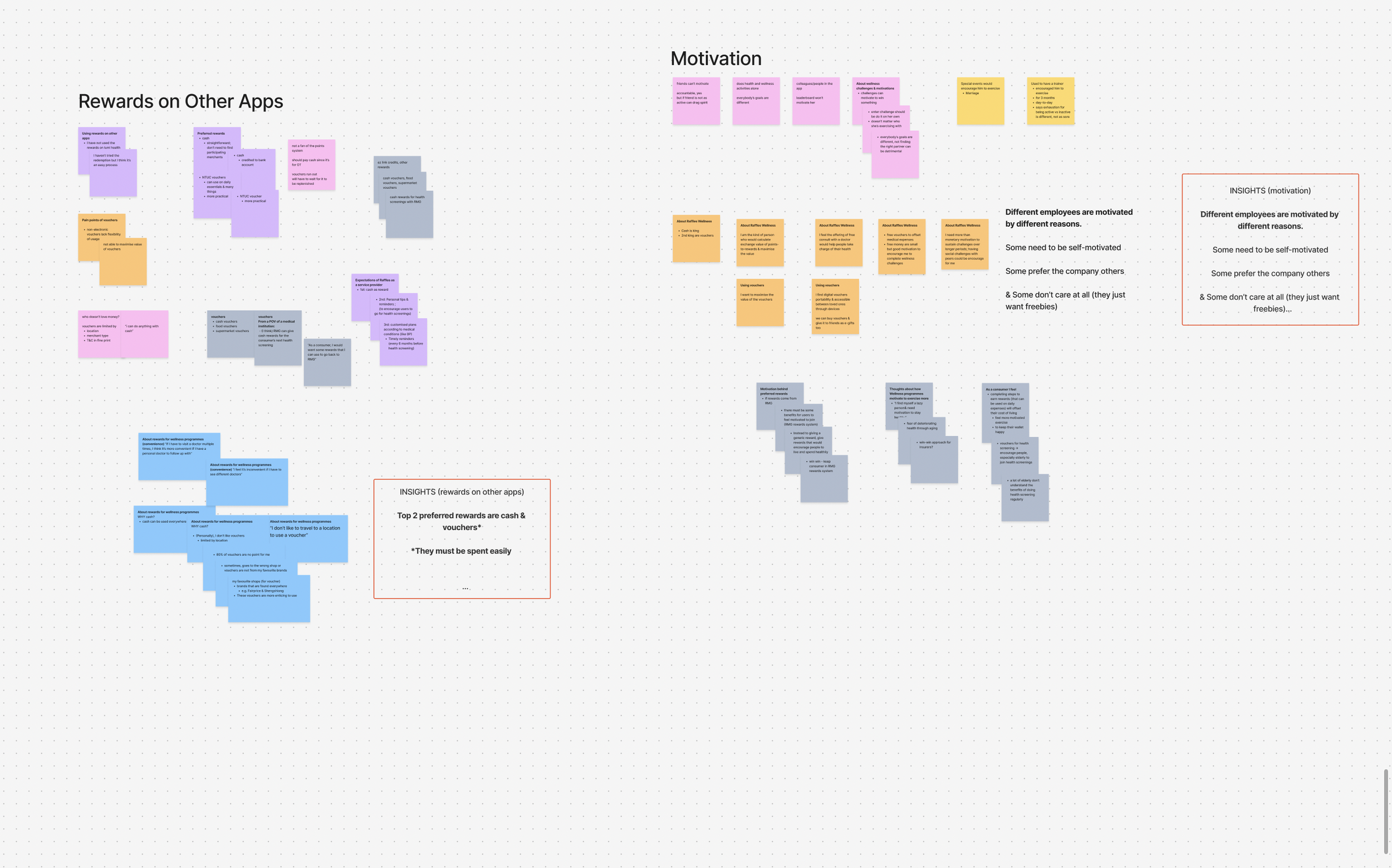
Two questions anchored the research: what would employees consider a successful wellness programme, and what would motivate or reward them for taking part? We expected employees to rate flexible, cash-like rewards above structured wellness benefits. We also explored financial incentives, peer support, and professional health guidance as possible motivational modes. I interviewed 6 employees and 2 HR administrators at existing Care partners, then mapped the patterns into hypotheses and design questions. Eight interviews could not support representative or causal conclusions.
Owned
Jan 2023 · affinity mapping: wellness apps, rewards & motivation
Participant voices
Relevance
“If it’s something that concerns my health and is personalised, I will pay more attention to it.”
Design implication
Prioritise personally relevant health content instead of asking employees to browse a generic library.
Value
“Cash is king, second king is vouchers. I would calculate the exchange value of points to rewards.”
Design implication
Make the value of points and the path from earning to spending easy to understand.
Duration
“I am willing to take part in challenges if it’s only three days. If it’s more than that, I’m not keen.”
Design implication
Design for short, achievable challenges; treat longer social programmes as a segment, not a universal motivator.
Anonymised interviews · 6 employees + 2 HR administrators · Jan 2023 · lightly edited for readability
Key research findings
01
Visible value was easy to discuss
Participants compared points with cash and vouchers. This suggested making earning and use legible at the decision moment.
02
Motivation varied
Participants described intrinsic, social, guided, and reward-led motivations. The interviews did not establish which mode would sustain use.
03
HR needed operating support
HR representatives described participation and reporting needs. This informed a configurable programme hypothesis. We did not measure workload reduction or ROI.
Research limitations
Eight interviews cannot represent every employee or HR team. The discussion guides and interview notes exist in Notion, but I did not write up each session as cleanly as I should have. The affinity map carries more of the evidence trail than it should. Next time, I would document each interview immediately instead of filling gaps from the synthesis later.
Hypotheses
Three hypotheses turned patterns into testable product direction
01
Employer activation
The corporate relationship was the clearest route into participation.
02
Tangible exchange
Points needed visible value and something useful to redeem.
03
Personal relevance
One generic content feed would not motivate people with different goals.
Product decision · Decision 01
Employer-led wellness
Research evidence
Interviews with 6 employees and 2 HR administrators linked participation to HR-led programmes, relevant health content, and tangible rewards.
Hypothesis
The employer was the clearest route into participation. Rewards and relevance could then support return use.
Decision
Scope Wellness Zone as a corporate benefit reached from the Membership landing, with programmes run by HR.
Evidence
The POC reported 70% programme adoption within an eligible population of about 4,700. Product, HR activation, communications, and rewards were tested together.
Stakeholder Alignment + Information Architecture
We chose employer-funded wellness, not a public rewards product
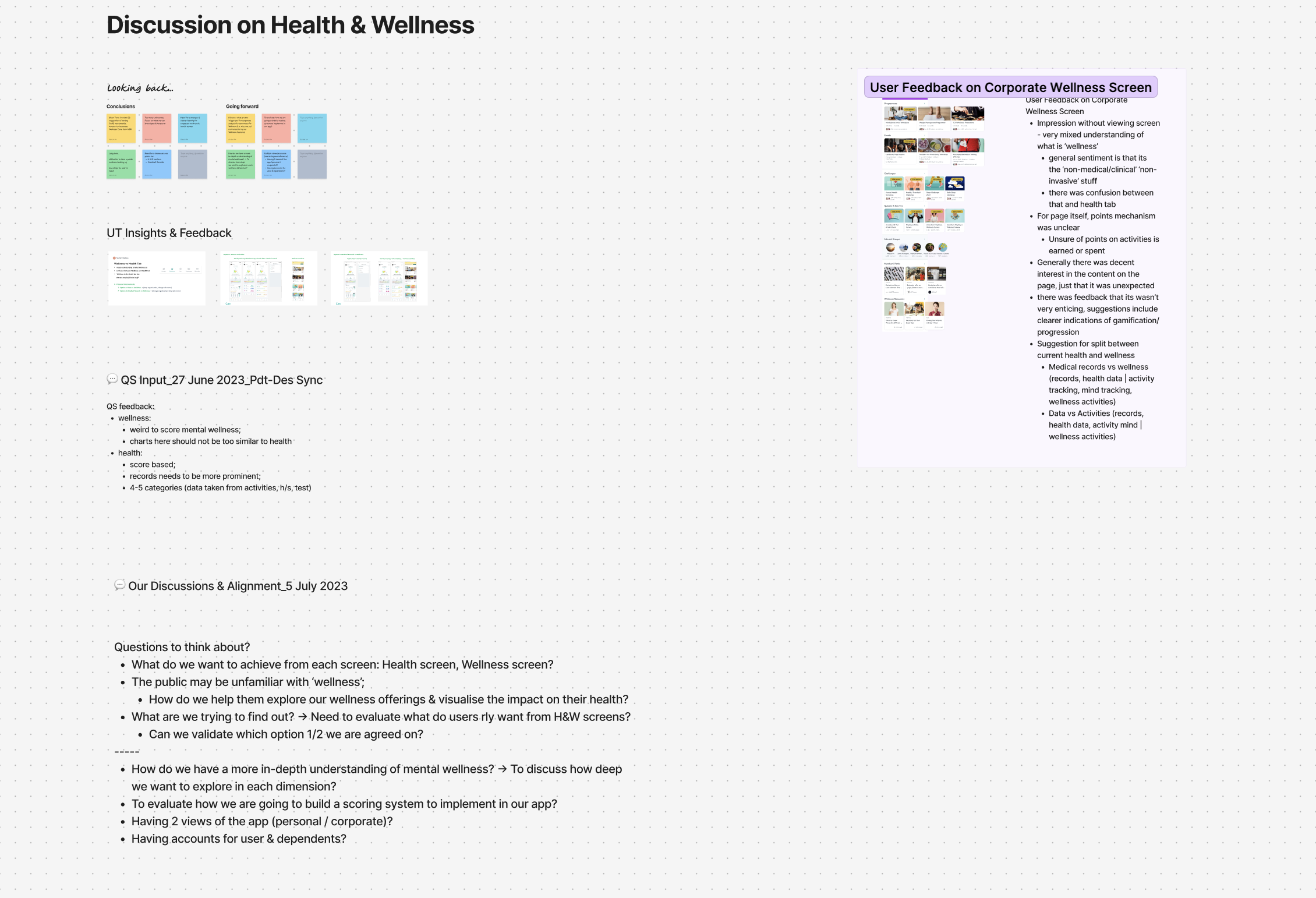
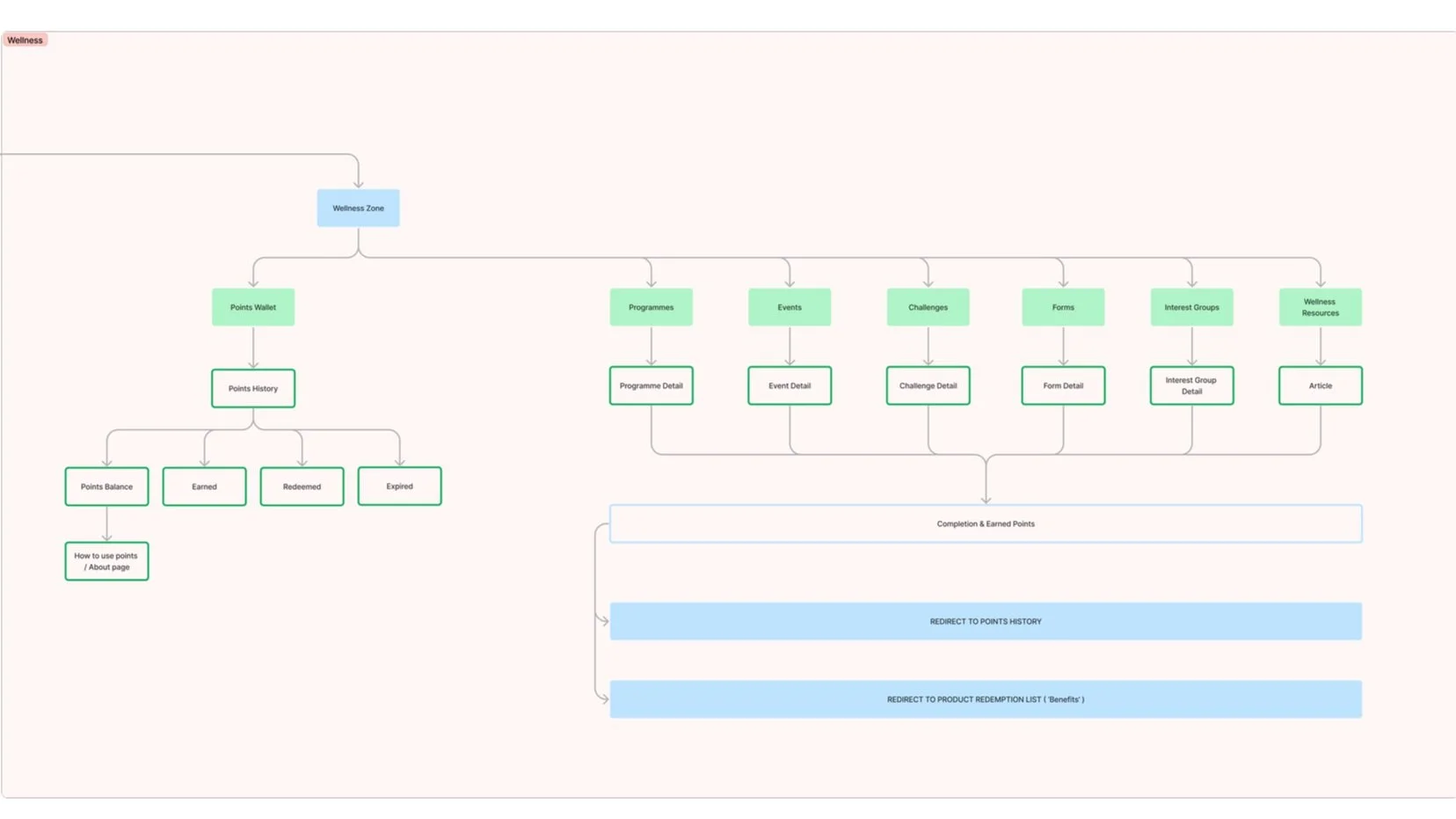
May and June interface explorations exposed the unresolved business model: public Wellness had no credible near-term points-funding path, while external loyalty partners added pricing and operating dependencies. I brought Product, Design, commercial leads, and the CPO into the trade-off. In July we narrowed to an employer-funded B2B2C route, while retaining Care’s familiar navigation and placing Forms, Programmes, Events, Challenges, and Points inside Wellness Zone.
Owned
Jul 2023 · discussion on Health & Wellness: UT insights, CPO feedback, product-design alignment
Owned
Oct 2023 · Wellness Zone sitemap: 7 core sections + completion-to-points redemption flow
Partner pitch
The prototype turned an abstract product into a commercial conversation
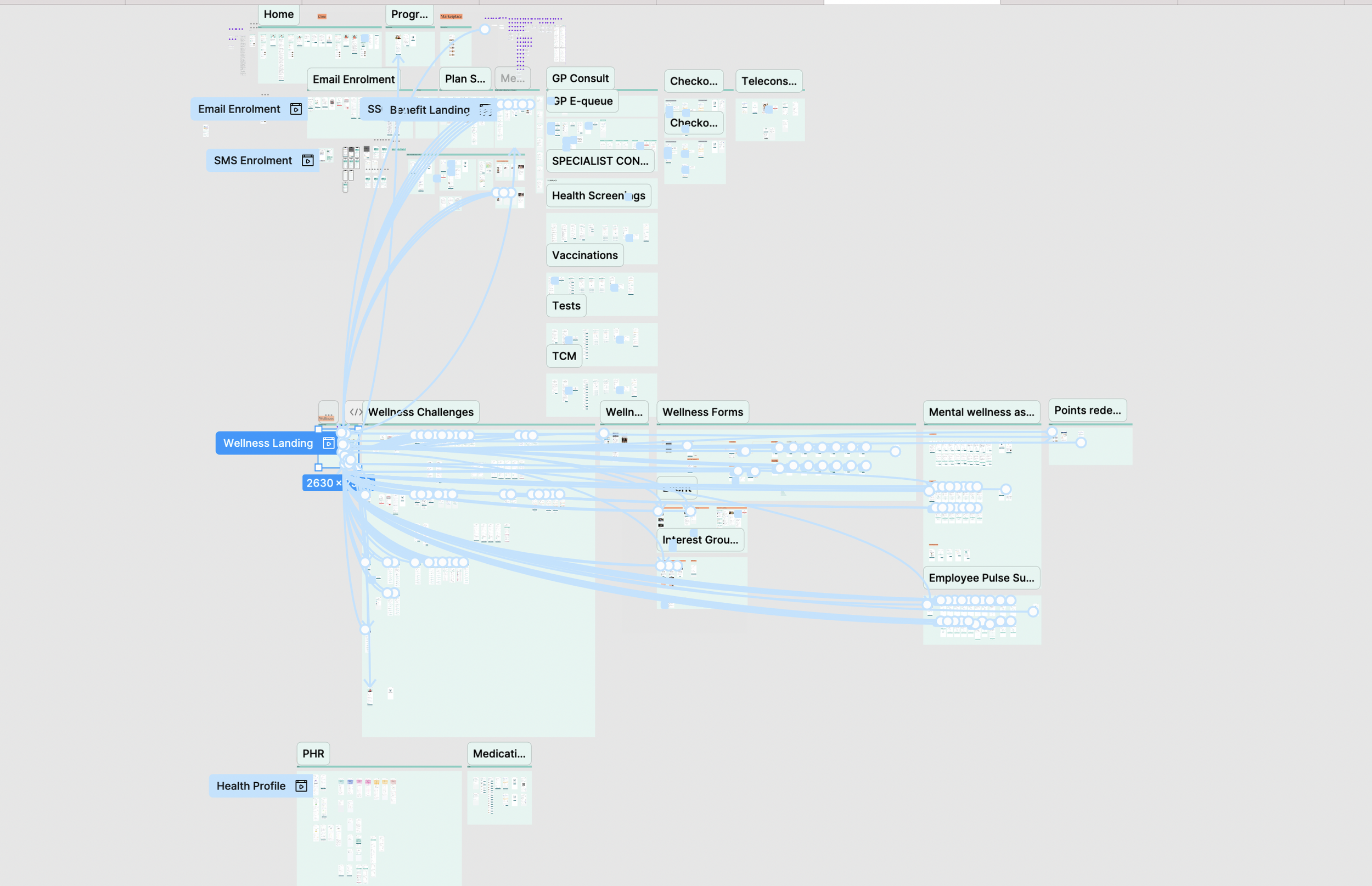
I worked with the C-suite, sales, and partner teams on the prototype they took into pitches. It covered enrolment, wellness features, health profile, and points redemption. Commercial and RFP work began in Q3 2023, followed by the POC SOW in Q1 2024. The map below comes from the prospecting work; the guided flows later in this chapter use a redacted version prepared in December 2023.
Owned
Q3 2023 · Figma prototype map used in prospecting · Owned
Iteration evidence · May–September 2023
We separated earning, spending, and completion after June feedback
The sequence starts with an assumption, then shows the concept used for feedback, what people misunderstood, the changes made across the following sprints. The April 2024 POC entry points follow below.
01May 2023
02June 2023
03June feedback
04Sep 2023
01 · May 2023 · Assumption
Start with a broad destination
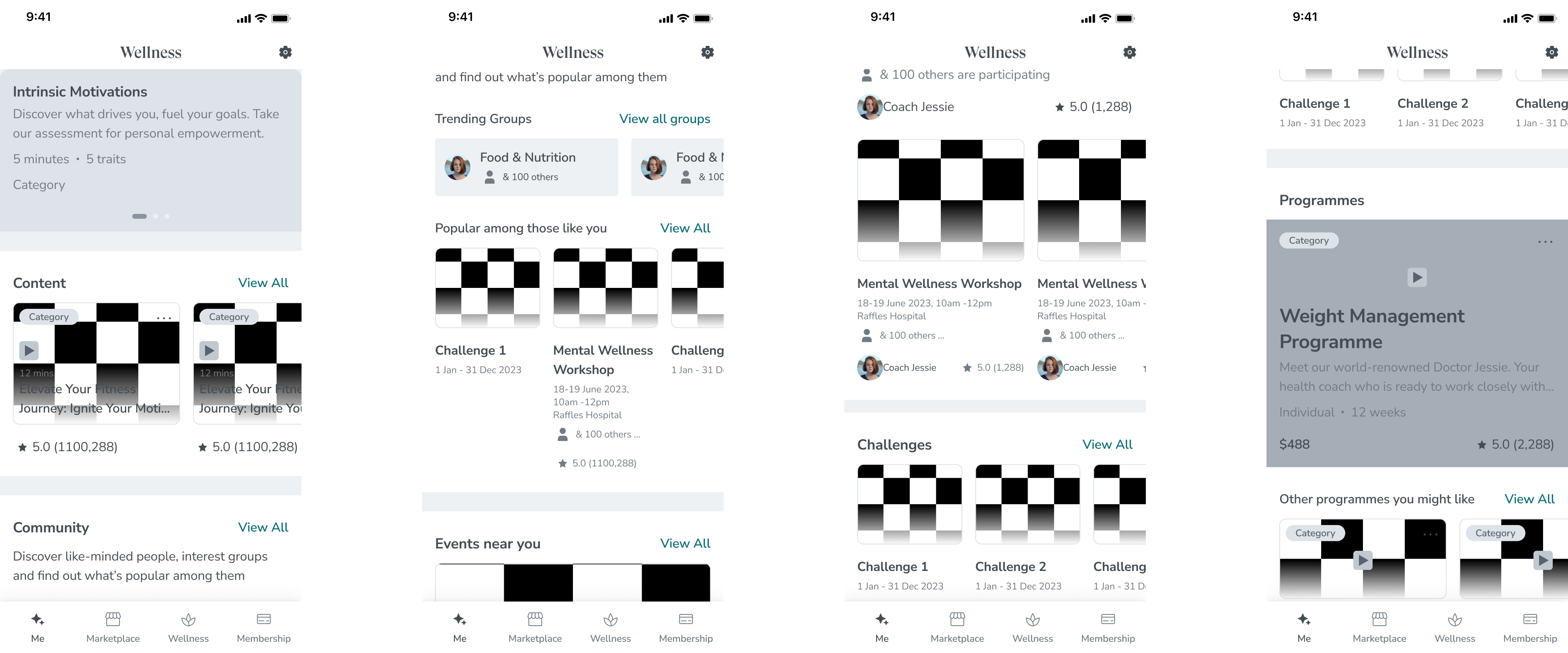
The low-fidelity concept grouped programmes, community, content, and services, but it did not yet establish a clear participation or value hierarchy.
Owned
02 · June 2023 · Concept
Make the exchange visible
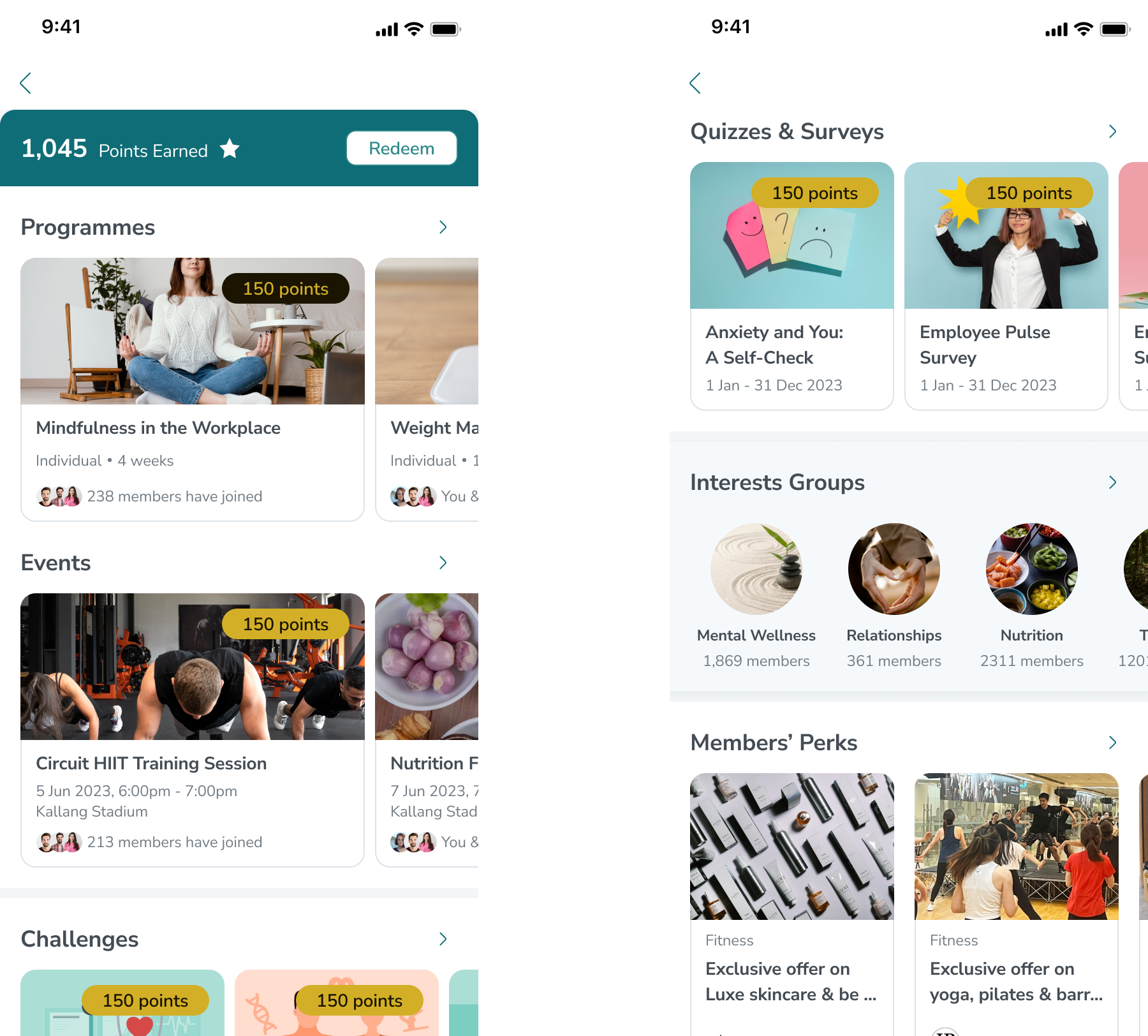
The concept introduced a points total and redemption entry, then connected activities, challenges, groups, perks, and resources.
Owned
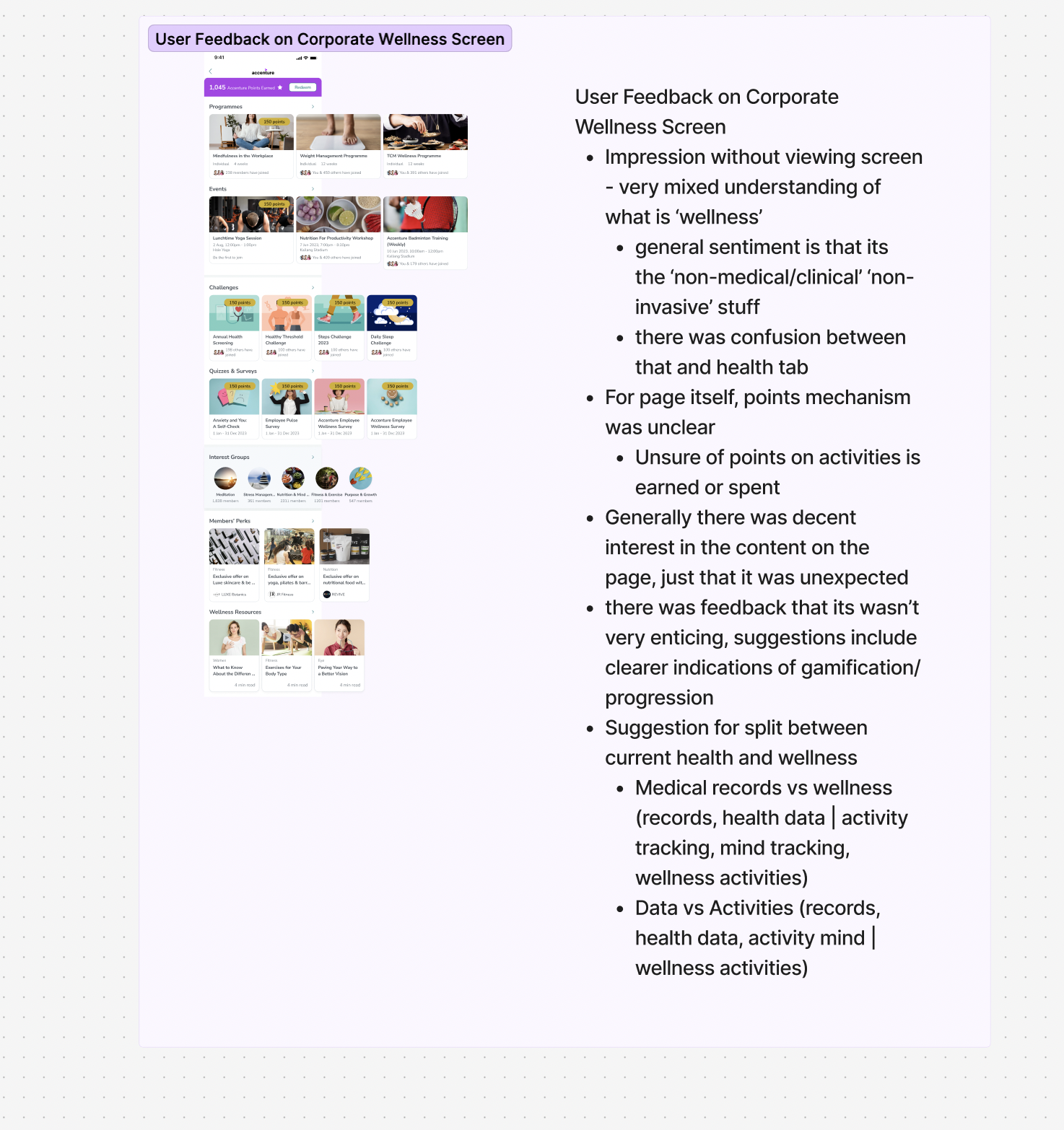
03 · June feedback · Observed
People saw points but could not explain them
People confused Wellness with Health, could not tell whether points were earned or spent, and wanted clearer progression.
Owned
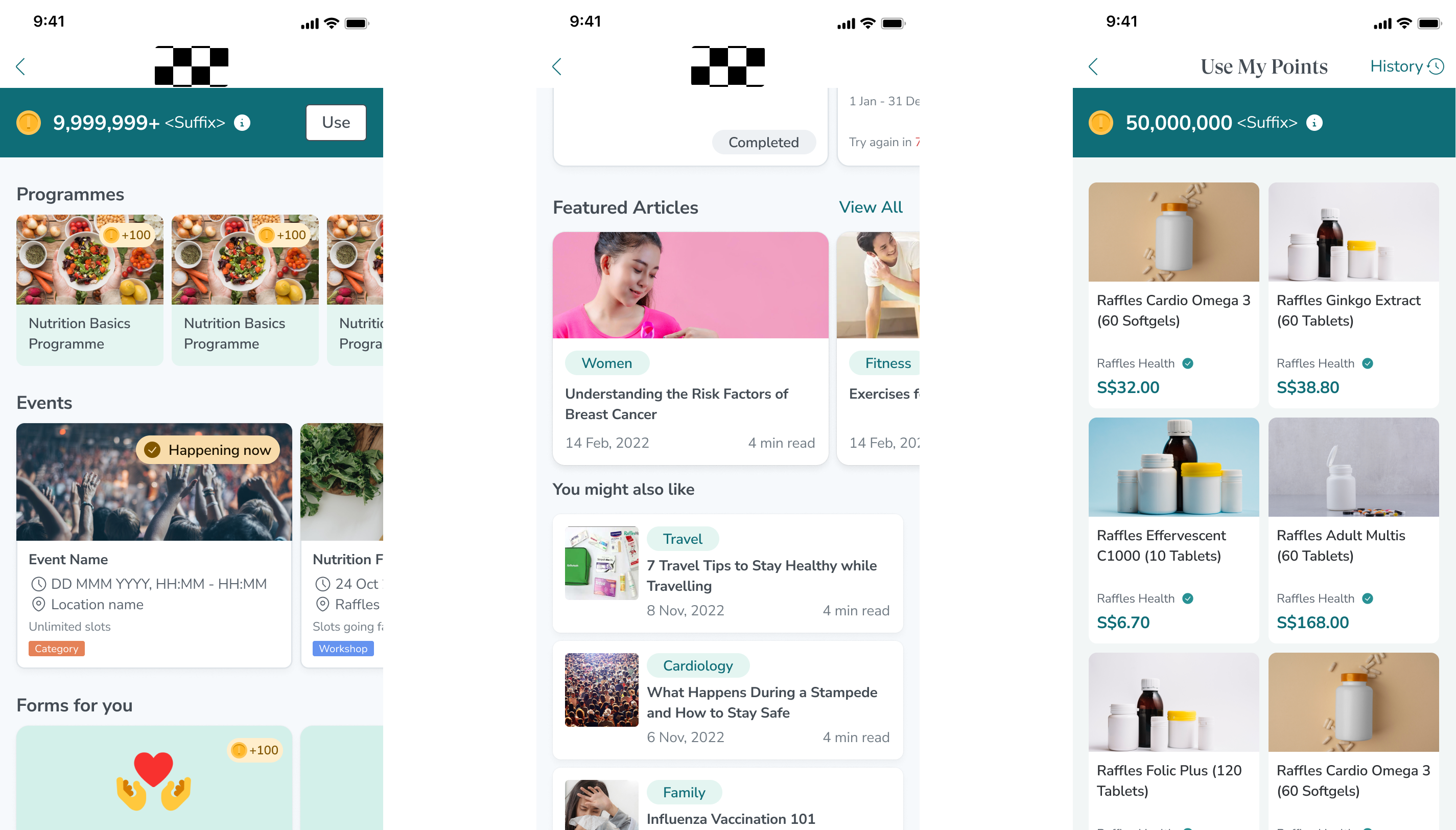
04 · September 2023 · Changed
Make participation legible
June feedback directly drove changes to points clarity, earning labels, hierarchy, and completion states across the following sprints.
Inspect the points decision
Read the September screen in three places: +100 on programme and form cards marks earning; Use beside the balance leads to spending; Completed marks an activity state. The June feedback asked whether activity points were earned or spent. These separate labels make that distinction visible.
The balances and +100 values are design examples. We did not measure rewards, usage, or whether people understood the revision.
The sequence documents how the hierarchy changed. The rollout tested the complete product and programme, so it cannot isolate one interface change as the cause of adoption.
Guided evidence · one shipped path and 2 prospecting concepts
Employee Pulse shipped; challenge and redemption remained prospecting concepts
Employee Pulse is the shipped path, shown through a redacted prototype recording. The Steps Challenge and Redemption flows are earlier prospecting concepts, not evidence that those interactions shipped. Together, the 3 flows show how value, personal relevance, and employer activation became discussable with product, engineering, and prospective clients.
Understand why the form matters, how long it takes, and whether the response was submitted.
Design response
A short introduction, bounded questions, and an explicit completion state turn a broad invitation into a task employees can understand.
Decision detail
One question stays in view with progress, required-answer feedback, an exit warning, and a dedicated Survey Complete state.
Ownership
I owned the employee interaction. Content, engineering, product rules, and delivery were collaborative.
Evidence boundary
This is the shipped Employee Pulse path. The artifact proves the interaction states. Completion uplift, response quality, and any points effect were not measured.
ProductionOwned
Shipped path · redacted prototype recording · user controlledOptional depth · Steps Challenge and Redemption
Track a steps challenge
User goal
Know what participation requires and see personal progress, points, and optional social comparison.
Design response
Tracker connection, progress history, completion, and leaderboard states make effort visible for employees motivated by progress or peers.
Evidence boundary
The prototype moves through preset states. It does not demonstrate live step tracking or sustained participation.
Co-designed
Use the value earned
User goal
Translate an abstract points balance into a reward with a clear exchange value.
Design response
The flow connects the Wellness balance to browsable inventory and an explicit points choice at checkout.
Evidence boundary
The prototype demonstrates the proposed earn-and-spend loop. No redemption conversion claim is made.
Co-designed
Event flow · secondary evidenceEvent details, joining, and leaving applied the same pattern: show the practical information needed to commit, then make participation status explicit. It remains secondary because Form, Challenge, and Redemption explain the core participation-to-value argument more directly.
April 2024 · POC launch activation
Home and Benefits led into one Wellness Zone
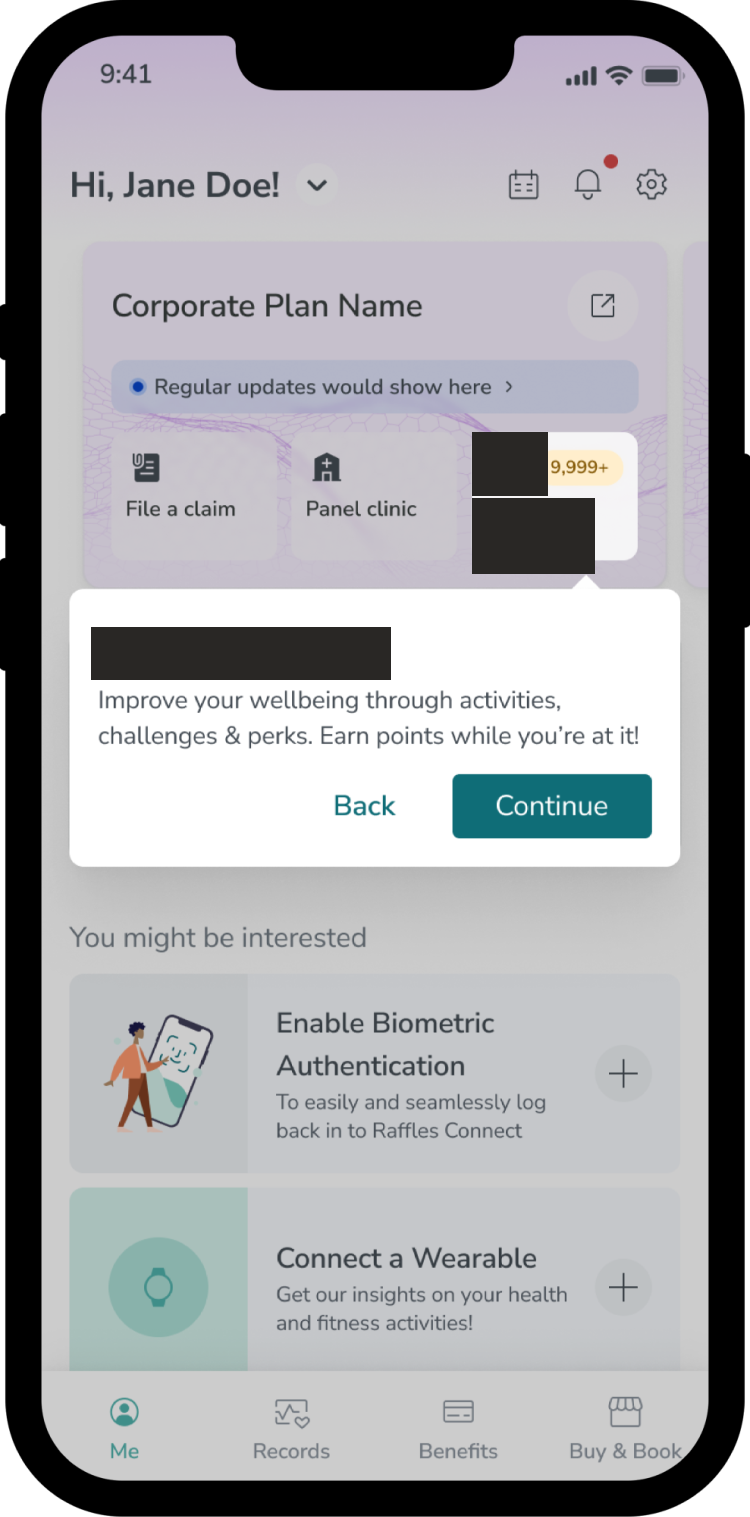
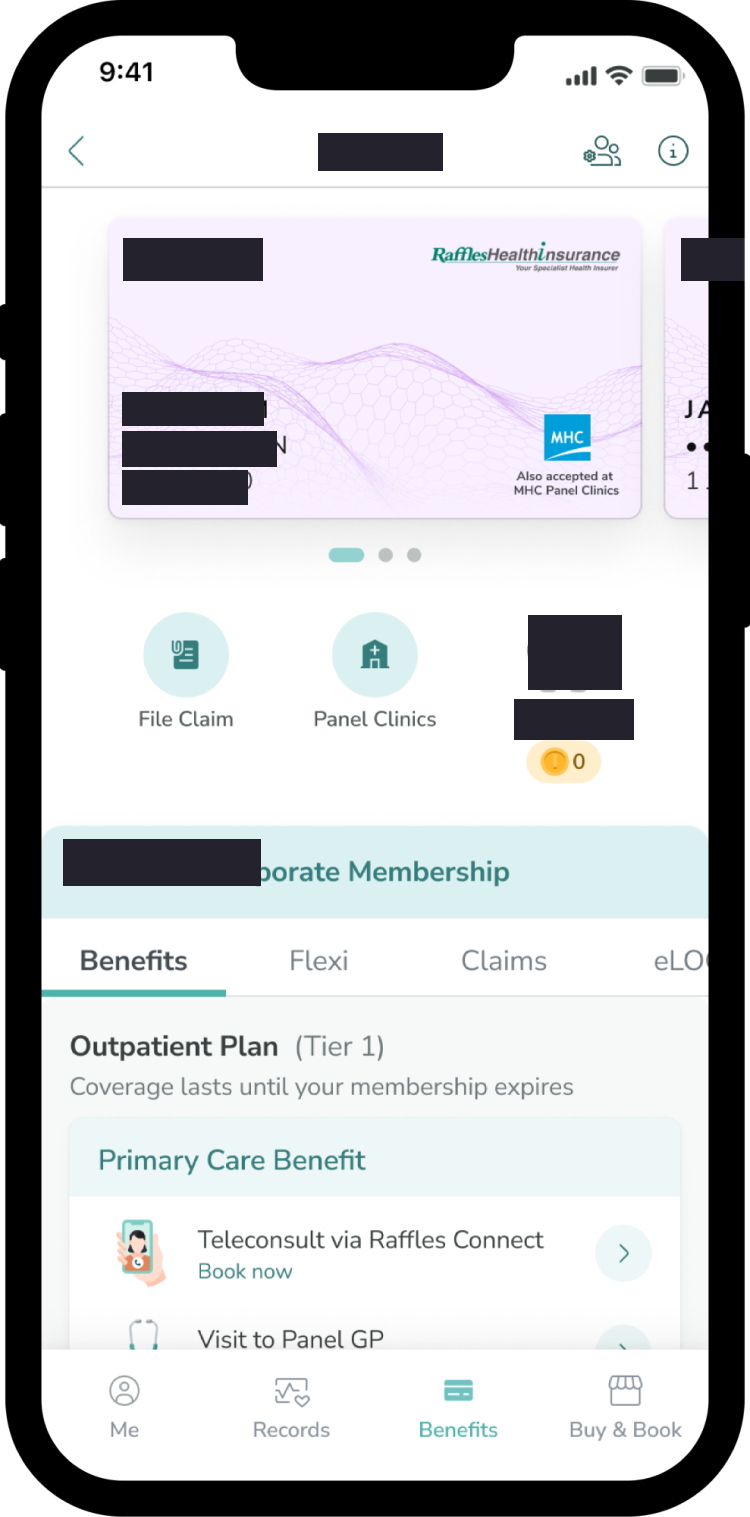
I kept Wellness within the corporate-benefits journey. A guided introduction on Home and a points-aware tile in Benefits gave employees two familiar ways into the same destination.
01 · Home
Introduce the destination where employees already begin.
02 · Benefits
Keep Wellness beside claims and panel clinics in the corporate-benefits context.
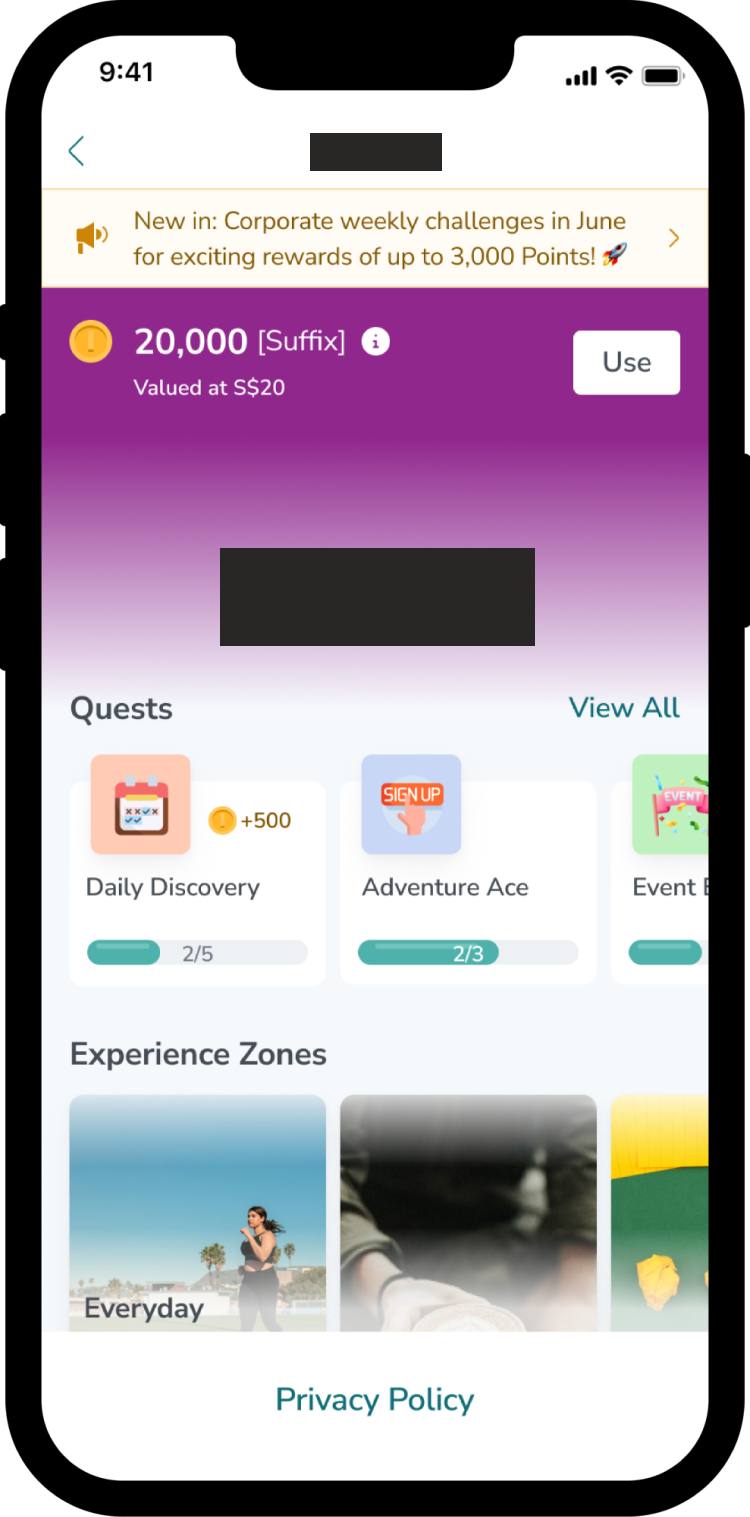
Shared · One Wellness Zone
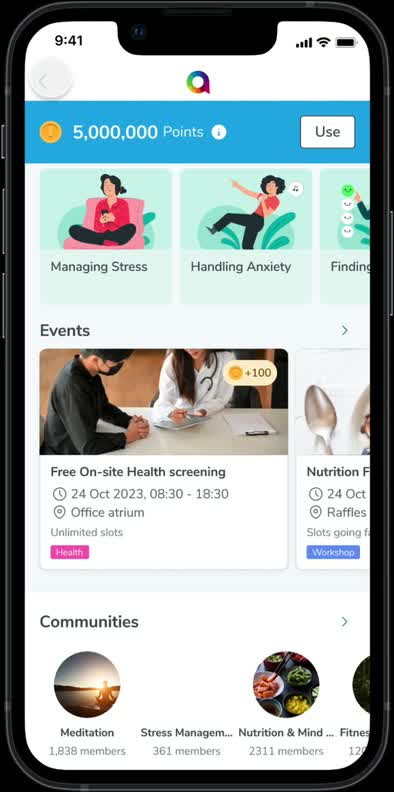
Make points, quests, and possible next actions visible in one destination.
These launch interfaces document the activation design. The POC tested the product, HR programme, communications, and rewards together, so adoption cannot be attributed to the interfaces alone.
Parallel employee + HR operating system
Employees participated in the app; HR configured the programme behind it
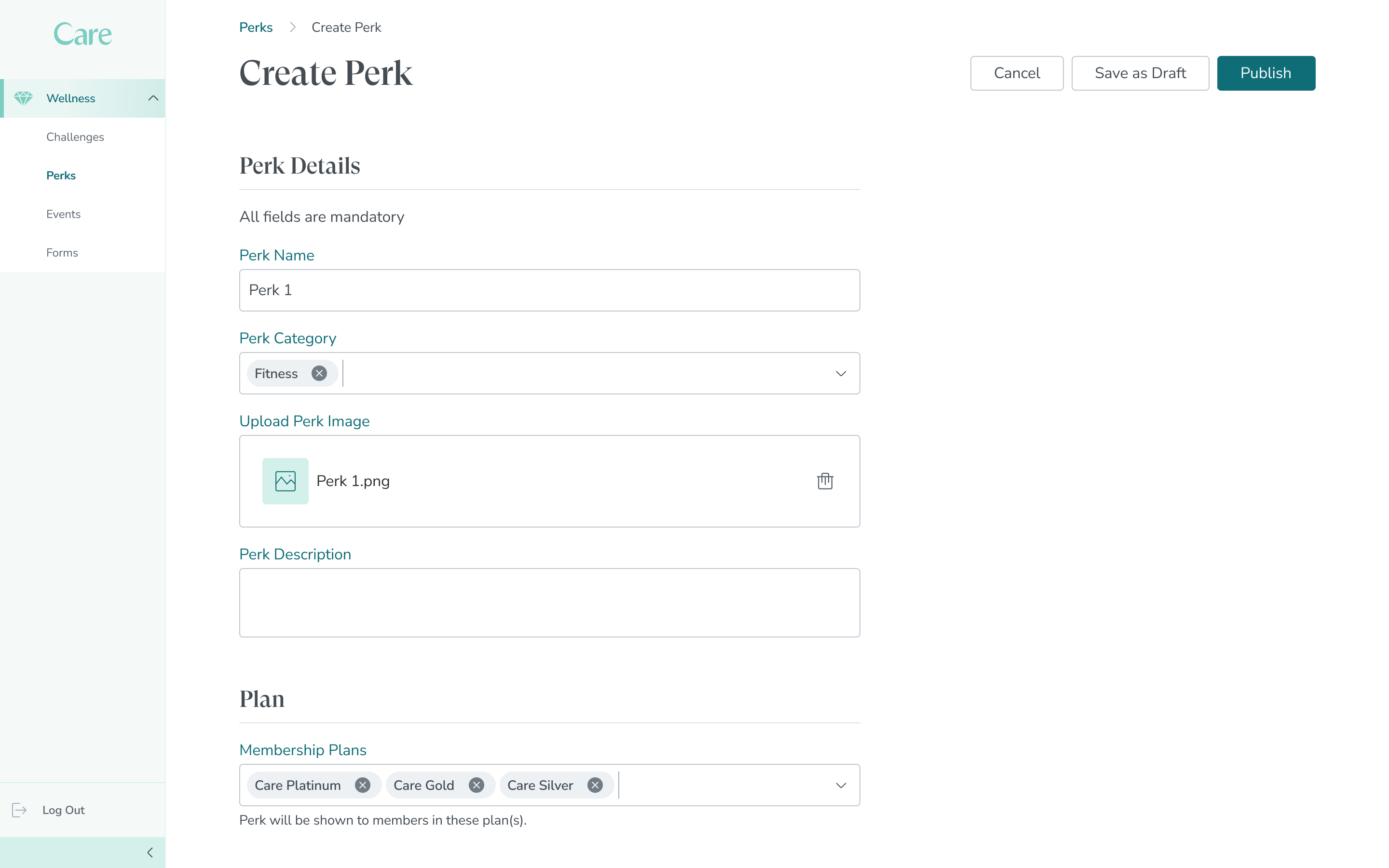
The employee app made challenges, points, events, communities, forms, and health content visible as one programme. In parallel, the HR tools let programme owners configure eligibility, activities, completion rules, points and scoring, and the perks employees could use. The analytics dashboard comes in Act 3.
These screens document the system's configurable scope. We did not measure a reduction in HR workload or whether any configuration caused participation.
Act 1 · Outcome
Programme adoption did not establish lasting product value
70%
reported programme adoption within an eligible population of about 4,700 employees and dependants during the Apr–Nov 2024 POC
~20%
programme users relative to roughly 20,000 Raffles Connect MAU at the time
≈3
monthly Wellness sessions among engaged users; retention and feature causality were not measured
Q1 2024 SOW
signed after prototype-led prospecting and commercial work that began in Q3 2023, before production code existed
The Q1 2024 SOW led into a live POC from April to November 2024. The programme showed interaction and adoption signals, but it did not isolate starts-to-completions, repeat completion, or the effect of any individual feature. Programme servicing remained high-touch, while points use was uneven and concentrated near expiry.
Follow-through + proposed next test
When I left after November 2024, I documented the design and operating gaps and handed the work to the PM and continuing team. The next test is proposed, not performed: instrument Form exposure → start → completion → repeat completion, then compare cohorts with standard versus lighter HR activation.
Act 2
The Exchange: turning participation into redemption
// How to read the evidence below
LiveIn market and verified on the stated date.
ProductionShipped and previously in use; since superseded.
UnshippedDesigned and handed off; did not ship.
OwnedMine end to end — research, decisions, deployment, iteration.
Co-designedDesigned with the squad; shared decisions.
Product decision · Decision 02
Rewards as engagement infrastructure
Research evidence
Participants compared point values with cash and vouchers, asked how points expired, and preferred short, achievable challenges.
Hypothesis
Points needed a clear value, a visible balance, and something useful to buy. Earning alone was not a complete experience.
Decision
Co-design an earn-and-spend loop across wellness activity and marketplace redemption, then standardise points, stock, and delivery states.
Evidence
Live Wellness Zone and Use My Points surfaces now close the loop. The current and previous marketplaces both reached production; no commerce performance metric is claimed.
Rewards
Points needed a usable path from earning to spending
I designed the exchange around browsable inventory, clear stock and delivery states, and a points balance that reads like money.
The earn mechanic
Employees earned points through events, forms, and challenges, then spent them on corporate perks. The squad co-designed the points mechanics; I owned the wellness surfaces from research through iteration.
Live in market
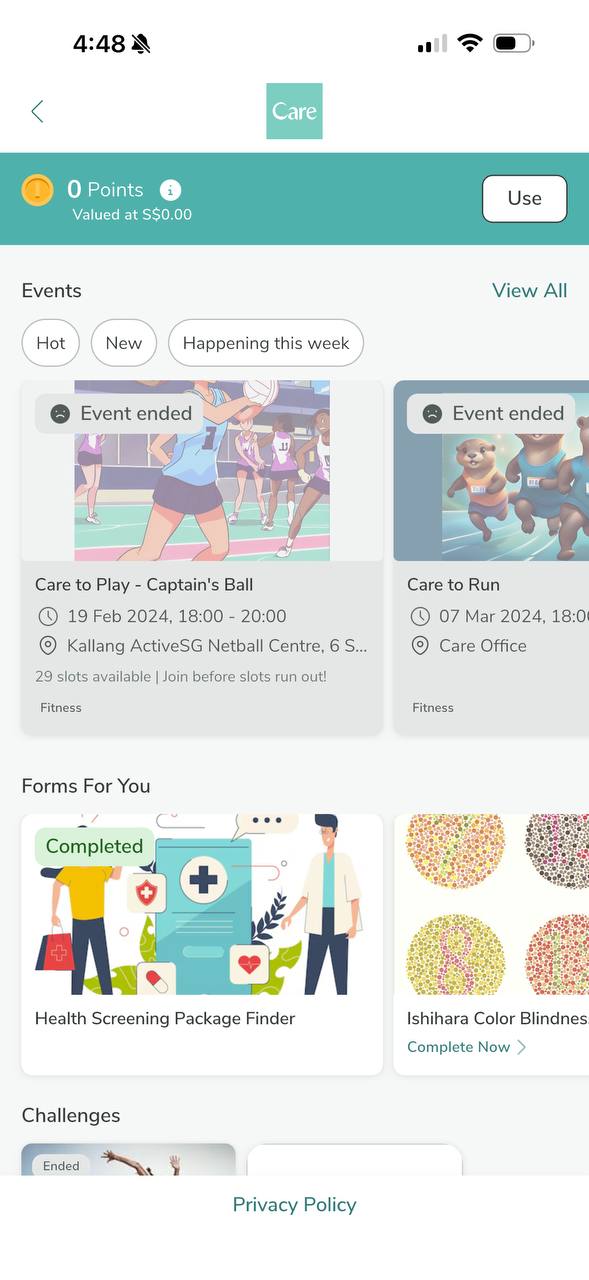
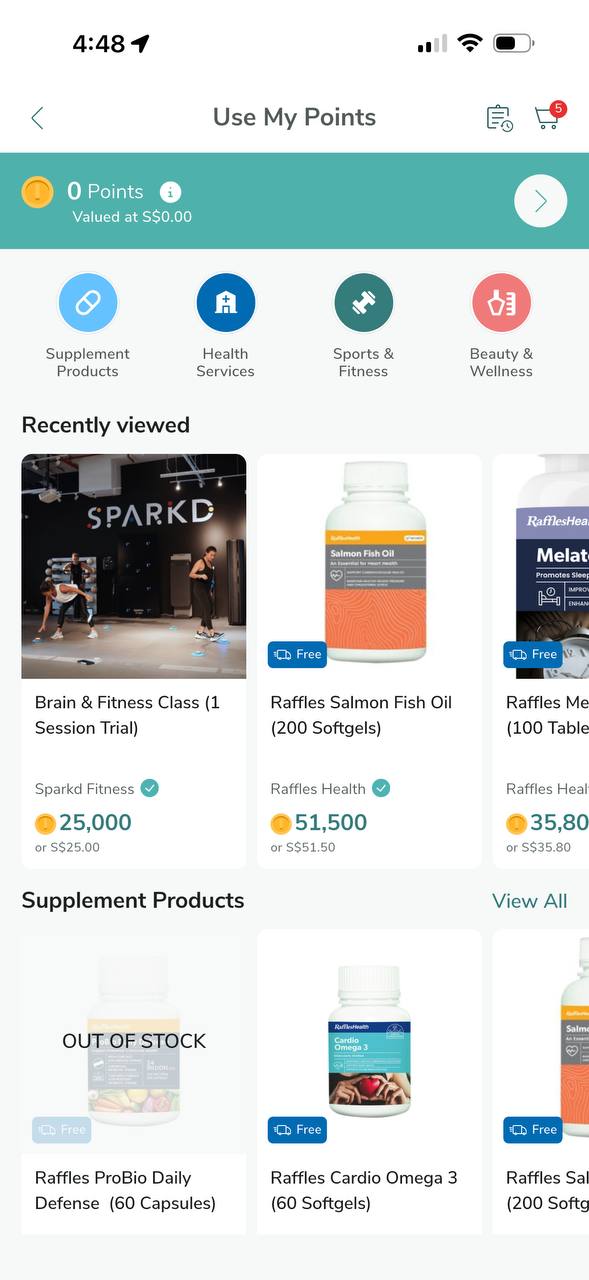
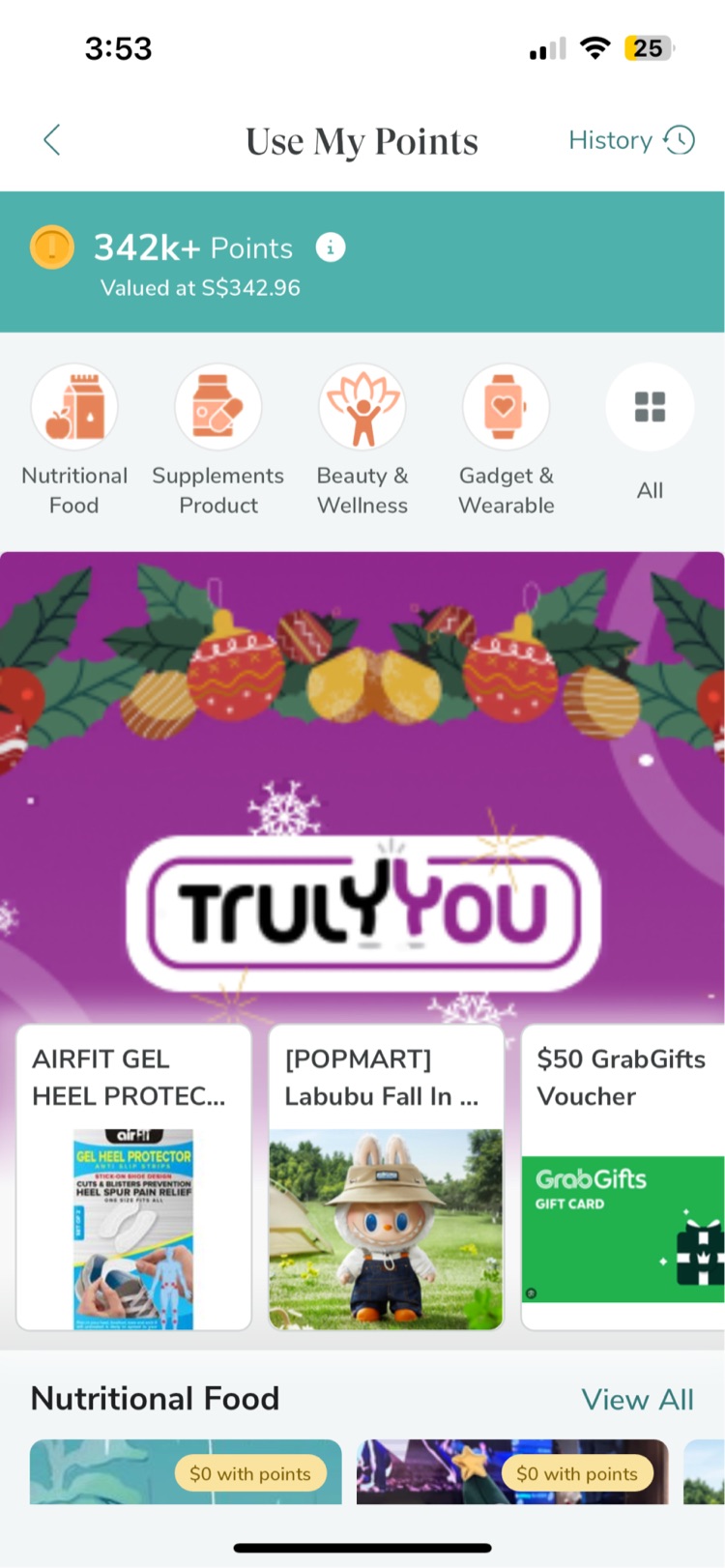
These August 2026 captures show the Wellness Zone landing, Use My Points, and the marketplace it replaced. The live captures use a signed-out demo account, so both balances read zero.
Live · Aug 2026Owned
Wellness Zone: events, forms, and challenges. I took this from research through deployment and iteration.
Live · Aug 2026Co-designed
Use My Points: balance, categories, and product states. The squad co-designed the points mechanics.
ProductionCo-designed
The marketplace before the current design. It solved the same job differently.
Owned component redesign + usage guidance
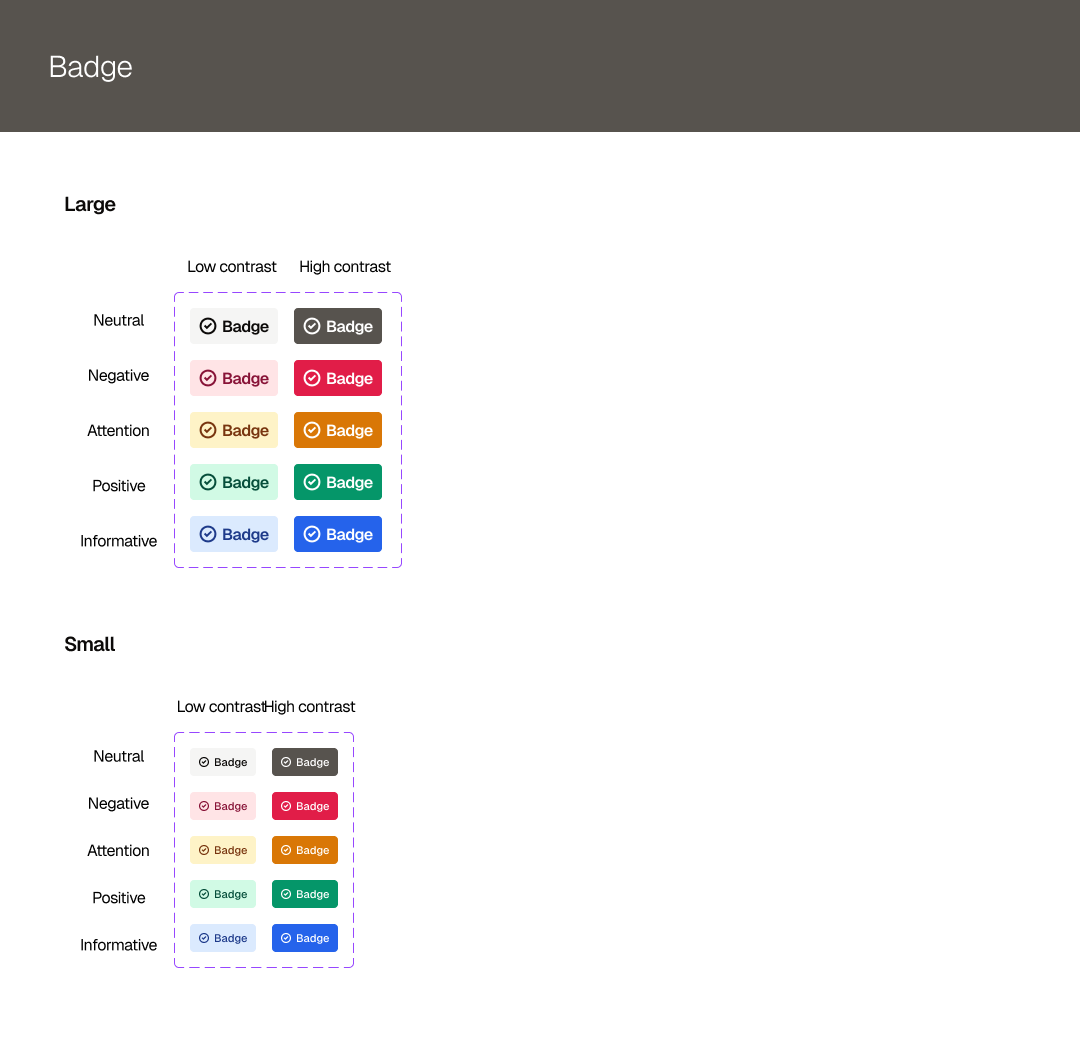
I separated earning, redemption, and status in badge guidance
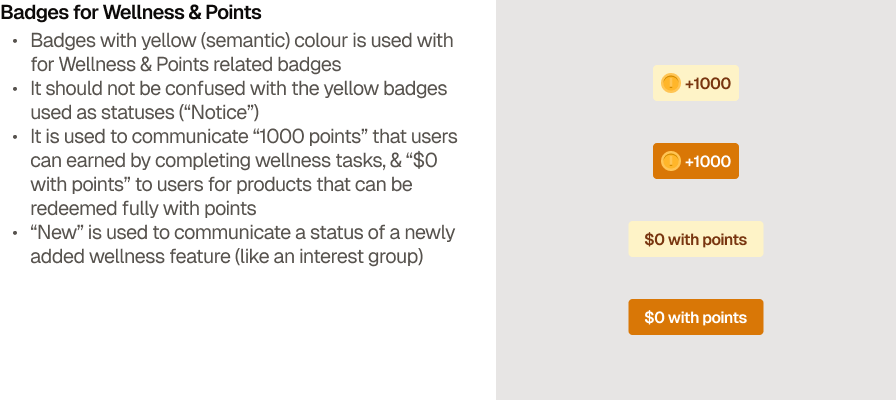
I redesigned badges and tags around semantic hierarchy, number limits, and reusable rules. The guidance distinguishes points earned from products redeemed entirely with points, and keeps yellow Wellness badges separate from notice and status badges.
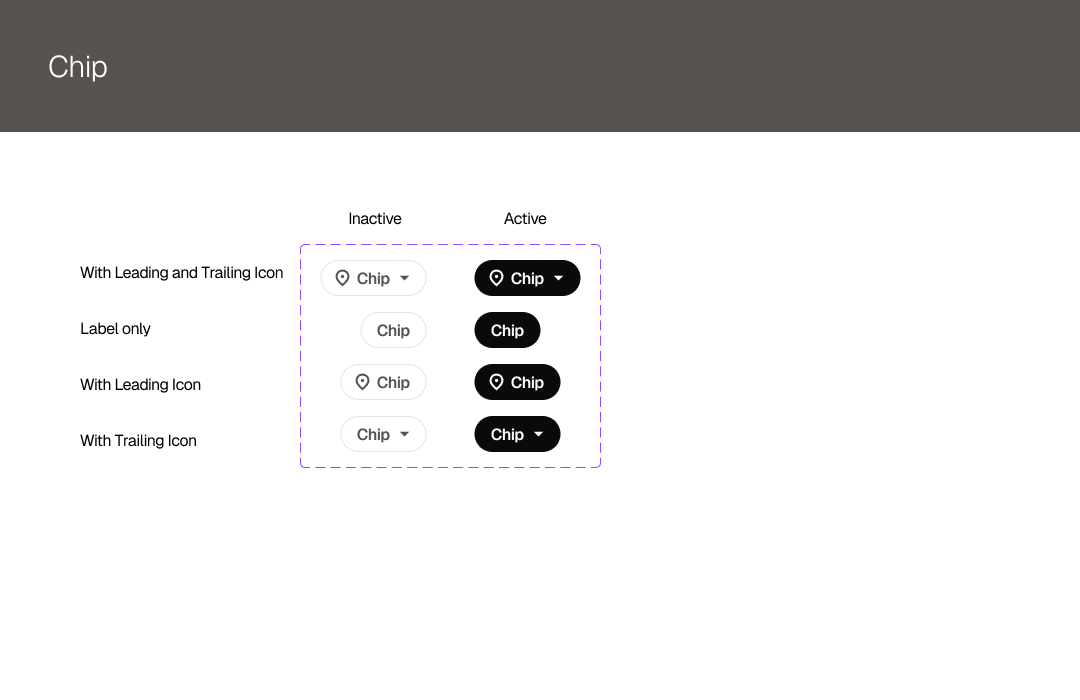
These artifacts document component variants and usage rules. They do not prove organisation-wide migration, adoption, governance ownership, or a measured maintenance outcome.
ProductionOwned
Badge and tag redesign: semantic hierarchy and number limits across wellness and points surfaces.
ProductionOwned
Usage guidance for points and state badges.
ProductionOwned
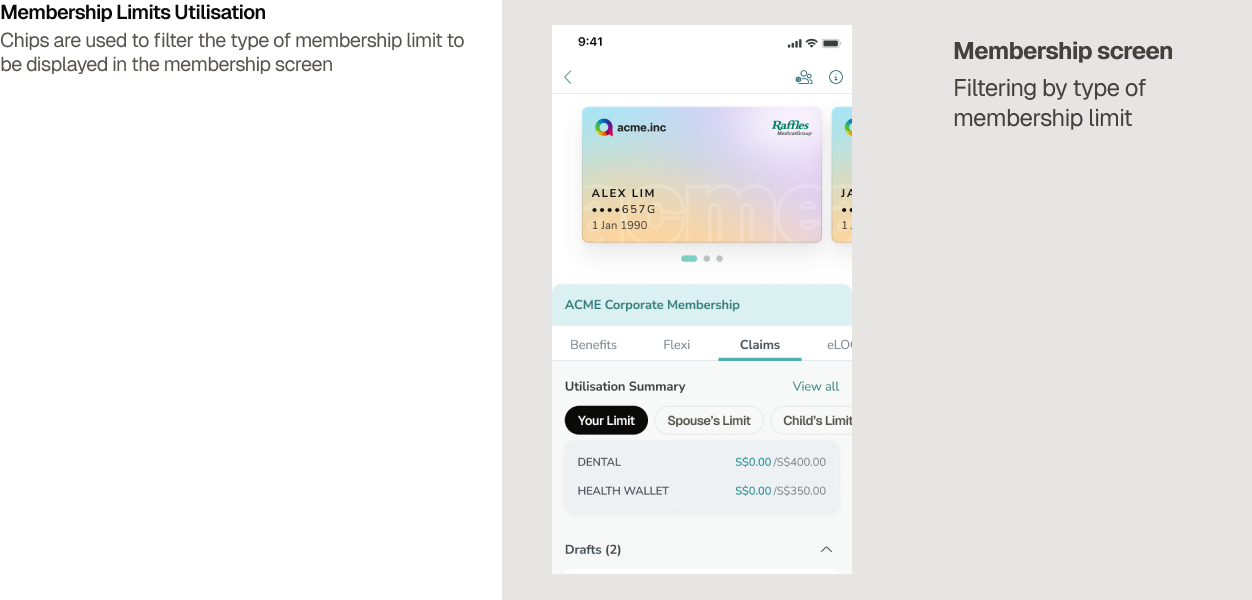
Chip variants for browsing inventory.
ProductionOwned
Chips used to filter marketplace categories.
Act 2 · Outcome
The exchange is live; commerce performance remains unmeasured
Live
The earn-and-redeem loop is in market. Wellness activity earns points; points buy real inventory. Verified Aug 2026.
Iterated
The marketplace shipped, was replaced, and shipped again. The earlier and current designs were both production surfaces.
Guidance
The badge and tag redesign documents semantic variants and usage rules across wellness and commerce; migration and adoption were not measured.
The hinge
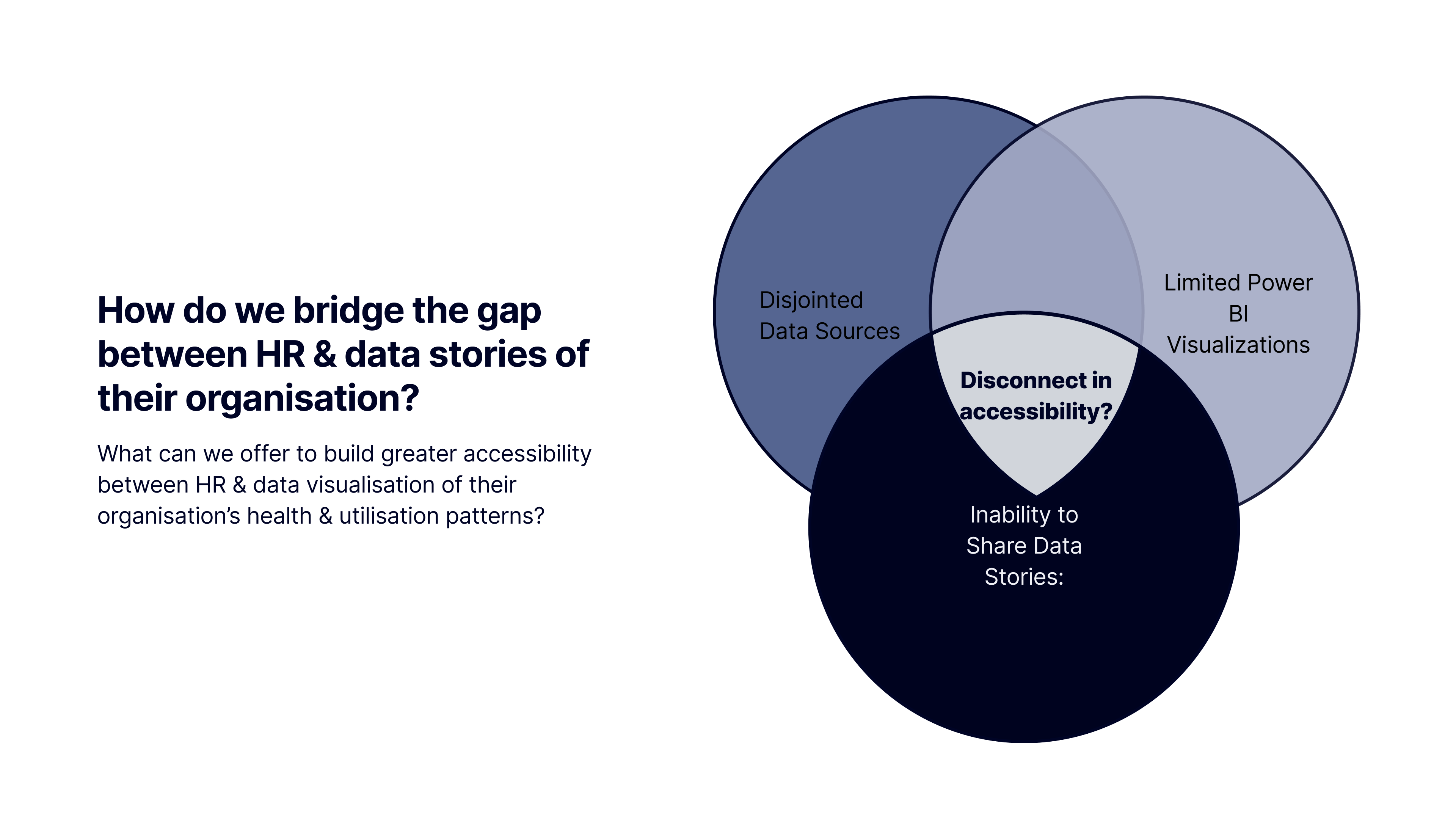
Redemptions showed what people spent points on and which programmes drove use. That data sat across the app, marketplace, and admin tools, leaving HR and sales without a clear view.
Product decision · Decision 03
Participation became employer insight
Research evidence
Benefits, health, participation, and redemption data sat across disconnected systems, leaving HR without a shared view.
Hypothesis
Participation data became useful when HR could compare programmes and make a case for where to invest.
Decision
Design one Power BI-compatible reporting layer spanning Benefits Plan, Health Report, and Wellness Zone analytics.
Evidence
Sales used the dashboard in client prospecting and identified a six-figure annual opportunity.
Act 3
A reporting design connected benefits, health, and participation
Reporting · May–Aug 2024
HR had the data, but no shared view of it
Benefits, health, and participation data sat in disconnected sources. HR had no way to make the case for wellness investment. The dashboard also had to work in Power BI, so the visual system had to survive both tools.
Owned
The problem space: three gaps in data accessibility
What was built: three dashboard sections
One dashboard design spans benefits, health, and wellness
01
Benefits Plan
Four views: At a Glance, By Segment, Trend Comparison, and By Time Period. Each answers a question HR teams brought to the dashboard.
02
Health Report
BMI, blood pressure, and fasting glucose by department, age group, and plan, so HR could focus health interventions.
03
Wellness Zone analytics
Participation and points-redemption patterns from the employee app, surfaced for the HR and sales teams.
ProductionOwned
Benefits Plan · iteration 2 walkthrough
Constraint
Power BI changed what could survive beyond Figma
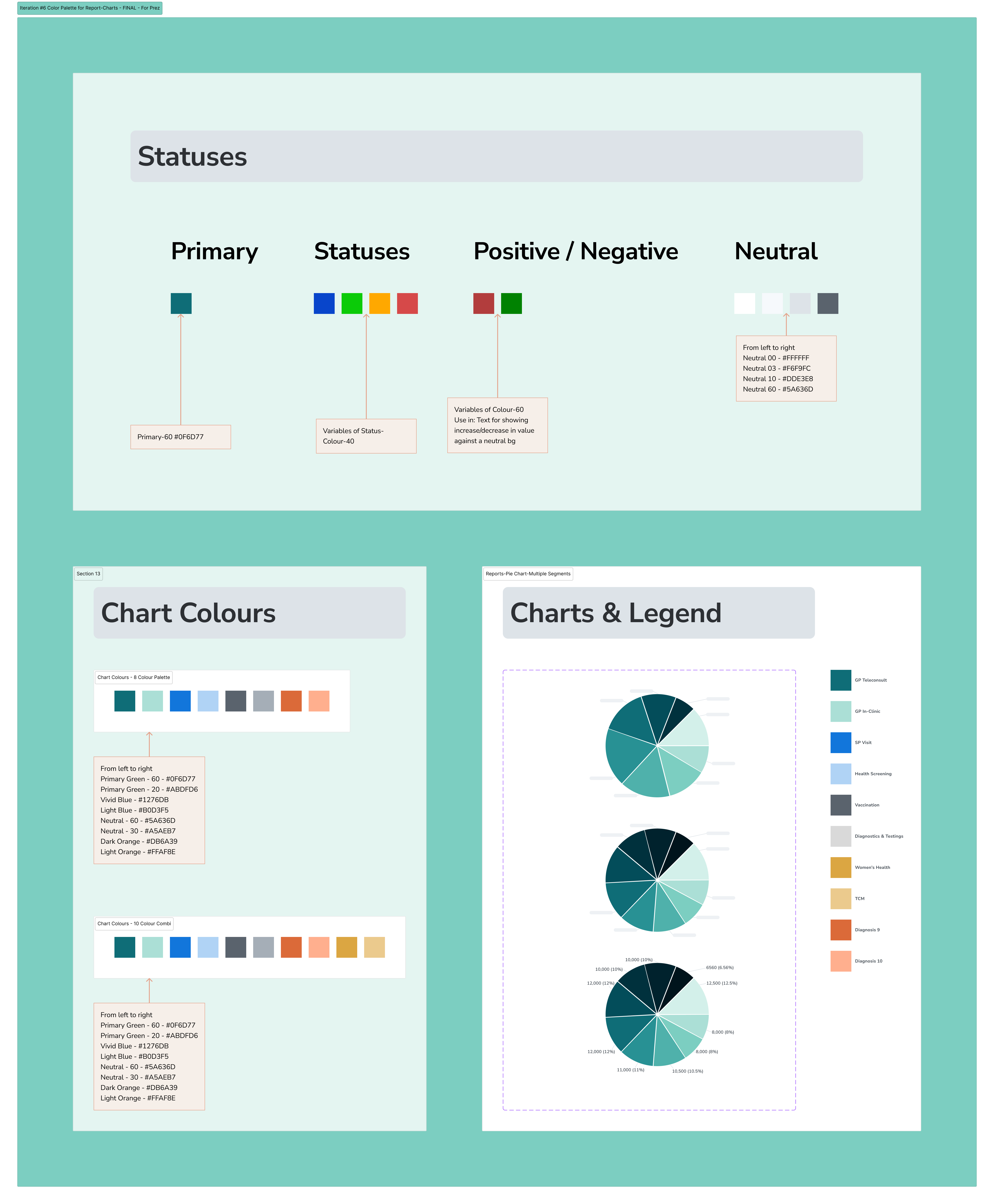
Colour had to separate the data
The palette had to distinguish each series at a glance and stay coherent. I went through six iterations before it worked.
Power BI set the limits
I checked every colour and chart type against Power BI’s rendering limits. Several Figma decisions changed once they had to work in the reporting tool.
The prototype had to sell
Sales needed a credible B2B demo for pitches. I designed the high-fidelity prototype for both the product team and the pitch.
Owned
Iteration 6 · final colour palette for report charts
Act 3 · Impact
Sales used the dashboard in prospecting; revenue remained unverified
6-figure
annual value identified for the B2B HR analytics line through client prospecting
Active use
sales used the dashboard designs in client demos and prospecting
Phase 1 ship
development and sales used the high-fidelity prototypes directly, without another handoff layer
Reflection
I now make evidence, ownership, and trade-offs visible enough for teams to challenge
Changed practice
I now bring research, product, and engineering into scope and architecture decisions earlier.
Evidence discipline
I separate interaction, completion, return behaviour, programme adoption, and commercial opportunity.
Next experiment
Compare Form completion and repeat completion across cohorts with standard versus lighter HR activation.